
This pet health content, “How to Calm a Dog During a Storm” was written by veterinarians, Dr. Debora Lichtenberg, VMD, and Dr. Pippa Elliott, BVMS, MRCVS. Petful publisher Dave Baker contributed to this article. It was originally published in 2013 and was last reviewed and updated on March 17, 2026
If you have questions or concerns, call your vet, who is best equipped to ensure the health and well-being of your pet. This article is for informational purposes only and is not a substitute for professional medical advice, diagnosis or treatment. See additional information.
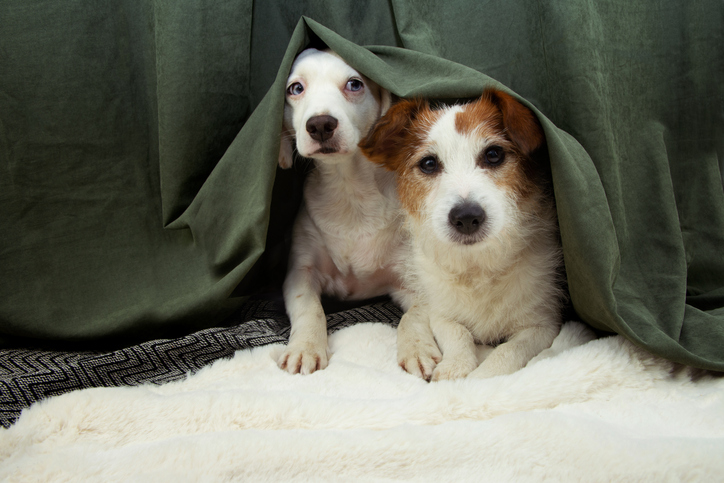
Thunder rumbles outside and your dog is already trembling, pacing, or trying to crawl under the bed. If this sounds familiar, you are not alone.
A 2013 study by Blackwell, Bradshaw, and Casey published in Applied Animal Behaviour Science found that between 25% and 49% of dogs show signs of fear in response to loud noises, with one in three displaying severe reactions such as destructive behavior, urinary incontinence, or attempts to escape.
This guide covers everything you need to know about how to calm a dog during a storm: what triggers the fear response, how to prepare before storm season, and what options are available for the most severely affected dogs.
- Storm phobia in dogs is triggered by multiple stimuli at once: thunder, barometric pressure drops, static electricity, and the smell of rain, not just loud noise.
- Between 25% and 49% of dogs show signs of fear in response to loud noises, with one in three displaying severe reactions.
- Systematic desensitization is the most evidence-supported long-term strategy. Start at least 8 weeks before storm season.
- Calming products like Adaptil and compression wraps such as the ThunderShirt work best when introduced before a storm, not during one.
- Trazodone is one of the most commonly prescribed situational anxiety medications in veterinary practice and has a strong safety profile.
- Comforting a frightened dog does not reinforce fear. Staying calm and present is supported by current veterinary behavioral science.
- Sileo (dexmedetomidine oral gel) is not currently recommended due to an unresolved overdose risk linked to a faulty syringe mechanism.
- If your dog injures themselves trying to escape or the phobia is worsening each season, see a veterinarian or veterinary behaviorist.
Don’t Guess When It Comes To Your Pet’s Care
Sign up for expert-backed reviews and safety alerts all in one place.

Don’t Guess When It Comes To Your Pet’s Care
Sign up for expert-backed reviews and safety alerts all in one place.
Why Are Dogs Scared of Thunderstorms?
Storm phobia in dogs is not a simple reaction to noise. According to Crowell-Davis writing in Today’s Veterinary Practice, dogs respond to a cluster of storm-related triggers simultaneously, including changes in barometric pressure, static electricity, low-frequency rumbles, darkening skies, and the smell of rain. This multi-sensory overload explains why some dogs start showing anxiety signs well before a storm arrives and why audio-only desensitization sometimes produces incomplete results.
A 2005 physiological study by Dreschel and Granger measured cortisol levels in thunderstorm-phobic dogs and found them to be more than double baseline during storm exposure, with levels still elevated 40 minutes after the stressor was removed. Chronic elevation of stress hormones can contribute to recurrent skin infections, gastrointestinal issues, and a heightened sensitivity to other stressors over time.
Physical Signs of Storm Anxiety in Dogs
Recognizing anxiety early gives you more time to intervene. Common signs include:
- Pacing, whining, or trembling
- Freezing or refusing to move
- Low body posture, tucked tail, flattened ears
- Drooling or panting excessively
- Destructive behavior such as chewing furniture or scratching doors
- Attempting to escape through windows, fences, or crates
- Urinary or bowel incontinence
For more on related anxious behaviors, see our article on separation anxiety and nighttime distress in dogs.

How to Calm a Dog During a Storm
There is no single fix that works for every dog. The most effective approach layers environment management, behavioral tools, and for severe cases, veterinary intervention. The sections below cover each layer in order of how quickly you can implement them.
1. Create a Safe Den Before the Storm Hits
Dogs are den animals by instinct. Having a pre-established safe space gives your dog somewhere familiar and secure to retreat to. The University of Pennsylvania School of Veterinary Medicine recommends providing a voluntary den rather than forcing the dog to confront the fear, noting that forced confinement during a fear event increases anxiety rather than reducing it.
How to set up a storm den:
- Choose a small, interior room or a crate your dog already uses willingly
- Layer the space with a familiar blanket and an item of your worn clothing
- Add a favorite toy and leave high-value treats inside on normal days to build a positive association
- Keep the den accessible at all times, not just during storms
Do not force your dog into the den or block the exit. Voluntary retreat reduces anxiety. Forced confinement during a fear event increases it.
2. Manage the Environment During the Storm
Simple environmental adjustments can meaningfully reduce what your dog experiences:
- Close windows and doors to reduce the sound of thunder and prevent escape
- Draw curtains or blinds to block lightning flashes that trigger startle responses
- Turn off the television to avoid adding extra audio stimulation
- Play calming music at a low volume. Wells, Graham, and Hepper (2002) found classical music increased resting behavior and reduced vocalization in shelter dogs. Kogan, Schoenfeld-Tacher, and Simon (2012) replicated similar findings in kenneled dogs.
- Stay calm yourself. Dogs read human body language closely and anxious hovering can signal to your dog that their fear is justified.
A note on reassurance: the old advice that comforting a frightened dog reinforces fear has been challenged by current veterinary behavioral science. As outlined in the UPenn Veterinary Behavior Medicine handout, fear is an involuntary response that cannot be altered by petting or kind words. Staying calm and present will not make things worse. For related guidance, see our dog behavior and training hub.

How to Calm a Dog During a Storm at Night
Nighttime storms are often more distressing because the household is quiet and your dog may wake from sleep already in a panic. A few targeted adjustments help:
- Keep the safe den in or adjacent to your bedroom so your dog does not feel isolated
- Use a white noise machine or fan near the sleeping area to mask sudden thunder claps
- Consider a pheromone diffuser plugged in near the sleeping area
- If your dog seeks contact with you during the night, allowing this is unlikely to cause harm and may reduce their cortisol response
If nighttime storm anxiety is causing significant sleep disruption, speak to your vet about trazodone administered in the evening as a short-term situational option.
Desensitization: The Long-Term Solution
Systematic desensitization paired with counter-conditioning is one of the most commonly recommended long-term behavioral strategies for noise phobia in dogs. The protocol is described in detail in Karen Overall’s Manual of Clinical Behavioral Medicine for Dogs and Cats (Elsevier Mosby, 2013), and involves gradually exposing the dog to recorded storm sounds at a volume too low to trigger fear, pairing calm behavior with high-value rewards, and incrementally raising the volume over weeks.
It is worth noting, however, that the University of Pennsylvania School of Veterinary Medicine behavior handout takes a more cautious position on audio-only desensitization. UPenn’s clinical team notes that because a real storm involves barometric pressure, humidity, lightning, rain, and the smell of ozone, a recording cannot replicate the full sensory experience. They warn that audio-only practice may actually further sensitize some dogs to storm sounds rather than reducing their fear, and recommend focusing instead on environmental management and medication for moderate to severe cases.
The practical takeaway: audio desensitization is worth attempting for dogs with mild storm sensitivity, particularly if started well before storm season. For dogs with moderate to severe phobia, do not rely on it as a primary strategy and involve your veterinarian early.
How to Run a Desensitization Program
- Start at least 8 weeks before storm season, or as early as possible after identifying the phobia
- Use a high-quality recording of thunderstorm sounds; several are available on major streaming platforms
- Begin with the volume low enough that your dog shows absolutely no reaction. This is your baseline
- Play the recording during a positive activity such as a meal or a calm training session
- Increase the volume in small increments over multiple sessions, never progressing if the dog shows any sign of anxiety
- The goal over weeks is to reach realistic storm volume levels with the dog remaining relaxed and settled
Rushing the volume increase is the most common reason this protocol fails. Note that desensitization addresses the auditory component of storm fear. Some dogs also react to static electricity and pressure changes, which audio recordings cannot fully replicate.
For a broader overview of behavior modification, see our behaviors and training hub.

Calming Products for Storm Anxiety
Adaptil (Dog Appeasing Pheromone)
Adaptil is a synthetic analogue of the pheromone produced by lactating dogs. A placebo-controlled beagle study by Landsberg et al. (2015) published in the Veterinary Record found that dogs fitted with DAP collars had significantly lower global fear and anxiety scores during and after thunderstorm simulations compared to the placebo group.
A systematic review by Wong and Govendir (2021) published in Veterinary Evidence found moderate evidence that DAP reduces some behavioral signs of fear from thunderstorm noise, while noting that the evidence across all anxiety contexts remains variable. Adaptil is a reasonable component of a multimodal plan but should not be relied on as a standalone solution.
For best results:
- Start using an Adaptil diffuser or collar at least two weeks before anticipated storm events
- Position a plug-in diffuser in the room where your dog spends most time, or where the safe den is located
- Replace the diffuser refill every 30 days for continuous effect
The ThunderShirt and Compression Wraps
Compression wraps including the ThunderShirt and Anxiety Wrap apply gentle, consistent pressure across the dog’s torso. An open-label trial by Cottam, Dodman, and Ha (2013) at Tufts University Cummings School of Veterinary Medicine found that after five uses of the Anxiety Wrap, 89% of owners reported at least partial effectiveness for thunderstorm phobia, a proportion significantly higher than those reporting no effect (P = 0.001). A separate study of the Storm Defender Cape cited by Crowell-Davis found 70% of owners reported some improvement after four uses.
Compression wraps also help with:
Compression wraps work best when introduced on calm days before a storm. Applying one for the first time during an active panic response is less effective and can increase resistance to wearing it going forward. A ThunderShirt version is also available for cats.
Bach’s Rescue Remedy
Bach’s Rescue Remedy is a plant-based preparation at around $15 per bottle that some pet owners report helpful for mild anxiety. Controlled clinical evidence for its effectiveness in dogs is limited, and it should be considered a low-cost, low-risk adjunct rather than a primary intervention. Consult your veterinarian before use, particularly if your dog is on other medications.

- Do not apply a ThunderShirt or compression wrap for the first time during an active storm. The dog may associate the wrap with the fear event and resist wearing it in future.
- Do not use flooding. As Crowell-Davis notes, deliberately exposing a dog to maximum-intensity storm sounds can intensify anxiety and cause psychological harm.
- Never punish storm-related fear behaviors. Punishment adds stress, worsens the fear, and erodes the dog’s trust in you.
- If your dog attempts to escape through windows or screens, secure the area immediately before attempting any behavioral intervention.
- Do not rely on over-the-counter products alone if the anxiety is worsening each season. See your vet.
- Do not administer Sileo at home until the dosing syringe issue is resolved.
- Storm anxiety and separation anxiety frequently co-occur. If your dog shows distress when left alone, mention both to your vet as they often need to be treated together.
Medications for Storm Anxiety in Dogs
When behavioral tools and calming products are not sufficient, veterinary medication is an important part of the plan. As outlined in Karen Overall’s Manual of Clinical Behavioral Medicine for Dogs and Cats (Elsevier Mosby, 2013), medication works most effectively alongside behavior modification, not as a replacement for it.
Important: None of the medications discussed in this section should be administered without a veterinarian’s guidance. Dosage, timing, and suitability vary significantly depending on your dog’s weight, health status, and any existing medications. Always consult your vet before starting any prescription or over-the-counter treatment for anxiety.
Trazodone
Trazodone is a serotonin antagonist and reuptake inhibitor (SARI) that has become one of the most commonly prescribed situational anxiety medications in veterinary practice. A retrospective study of 56 dogs by Gruen and Sherman (2008) published in the Journal of the American Veterinary Medical Association found that trazodone was well tolerated across a wide dosage range and enhanced behavioral calming when used alongside behavior modification. A later randomized, double-blinded, placebo-controlled crossover trial by Kim et al. (2022) confirmed that a single dose of trazodone before a stressful event significantly reduced both behavioral and physiological signs of stress in dogs.
Common veterinary uses:
- Thunderstorm and noise phobias in acute situations
- Travel anxiety
- Post-operative cage rest and recovery periods
Safety profile:
- Few side effects at therapeutic doses in the majority of patients
- Well tolerated across a wide dosage range
- Use with caution in dogs with severe cardiac, liver, or kidney disease; disclose full health history to your vet
- Drug interactions are possible; always tell your vet about all current medications
Benzodiazepines
Drugs in the diazepam family are highly effective for acute, severe storm fear. According to Crowell-Davis, they not only reduce anxiety in the moment but carry amnesiac properties, meaning the dog may not fully consolidate a fear memory of the event. Over repeated storms this can gradually reduce overall sensitivity. Benzodiazepines require a prescription and should only be used under veterinary supervision.
Sileo (Dexmedetomidine Oral Gel): Not Currently Recommended
Sileo is an FDA-approved oral gel form of dexmedetomidine specifically marketed for noise phobia in dogs. However, the AVMA reported in July 2017 that the FDA had issued a safety warning after reports of accidental overdose linked to a faulty oral syringe mechanism. Despite revised labeling and additional training materials from the manufacturer, Zoetis, the overdose risk has not been fully resolved. Until the syringe design issue is corrected, we do not recommend home administration of Sileo. If your vet has previously prescribed it, discuss alternative options at your next appointment.
Here’s a look at Sileo’s faulty syringe mechanism:

Fireworks and Other Loud Noises
Most strategies that help a dog during a thunderstorm apply equally to fireworks and other sudden loud events. A few additional considerations for fireworks:
- Fireworks are often predictable. If a display is scheduled, you have time to prepare the den, start Adaptil two weeks in advance, and speak to your vet about situational medication
- Keep your dog securely indoors. Animal shelters consistently report a spike in lost and stray dogs in the days following major fireworks events
- Avoid taking your dog to outdoor fireworks events even if they appear tolerant. Dogs can bolt unpredictably if a burst goes off at close range
Dogs with generalized noise sensitivity beyond storms and fireworks may benefit from a broader behavioral assessment. The co-occurrence of noise phobia and separation anxiety is well documented by Blackwell, Bradshaw, and Casey and may require a combined treatment approach.

When to See a Veterinarian
Some nervousness during storms is common in dogs. But the following signs indicate the anxiety has crossed into a clinical problem requiring professional help:
- Your dog injures themselves trying to escape or hide, such as tearing nails or breaking through glass
- The anxiety is getting worse each storm season rather than staying stable or improving
- Your dog shows fear responses to other sounds or situations outside of storms
- Normal calming strategies and over-the-counter products have produced no meaningful improvement after consistent use
A veterinary behaviorist or a general practitioner with a strong behavior background can assess the full picture and create a tailored plan that may include prescription medication, a formal desensitization protocol, or a referral to a certified applied animal behaviorist.
Frequently Asked Questions (FAQ)
How do I calm a dog during a thunderstorm?
Guide your dog to a pre-established safe den in a quiet interior room. Close windows and curtains, reduce other noise sources, and play soft classical music. Use a ThunderShirt if your dog has been conditioned to it.
How do I calm a dog during a storm at night?
Position the safe den near your bedroom so your dog does not feel isolated. A white noise machine or fan helps mask sudden thunder claps. If your dog seeks contact with you during the night, allowing this will not reinforce fear and may reduce their stress response.
How do you calm a dog down during a thunderstorm quickly?
Guide your dog to their safe space, apply a ThunderShirt if they are conditioned to it, reduce light and sound stimulation in the room, and remain calm and present without anxious hovering. If a vet-prescribed medication has been dispensed for acute use, administer it per the prescribed instructions.
What are home remedies for dogs scared of thunder?
Home-based strategies include creating a dark, padded den space, playing classical music. Bach’s Rescue Remedy is a low-cost option some owners use for mild cases. These approaches are most effective when combined and introduced before storm season rather than applied for the first time during an acute fear event.
Why is my dog scared of thunder but not fireworks?
Thunderstorms involve multiple simultaneous triggers: barometric pressure changes, static electricity, low-frequency vibrations, and the smell of rain, in addition to sound. As noted by Crowell-Davis, dogs with heightened sensitivity to pressure or static may react more strongly to storms than to fireworks even when the latter are technically louder.
Does the ThunderShirt really work?
Clinical data suggests compression wraps are effective for a meaningful proportion of dogs. The Cottam, Dodman, and Ha open-label trial found 89% of owners reported at least partial effectiveness after five uses of the Anxiety Wrap. Results vary by individual dog, and the wrap works best when introduced gradually before a storm event.
References
- Blackwell, E.J., Bradshaw, J.W.S., and Casey, R.A. “Fear Responses to Noises in Domestic Dogs: Prevalence, Risk Factors and Co-Occurrence with Other Fear Related Behaviour.” Applied Animal Behaviour Science 145, no. 1-2 (May 2013): 15-25. https://www.sciencedirect.com/science/article/abs/pii/S016815911200367X
- Cottam, N., Dodman, N.H., and Ha, J.C. “The Effectiveness of the Anxiety Wrap in the Treatment of Canine Thunderstorm Phobia: An Open-Label Trial.” Journal of Veterinary Behavior 8, no. 3 (May-June 2013): 154-161. https://www.sciencedirect.com/science/article/abs/pii/S1558787812001190
- Crowell-Davis, S.L. “Noise and Storm Phobias and Anxiety in Dogs.” Today’s Veterinary Practice (2022). https://todaysveterinarypractice.com/behavior/noise-storm-phobias-anxiety-in-dogs/
- Dreschel, N.A., and Granger, D.A. “Physiological and Behavioral Reactivity to Stress in Thunderstorm-Phobic Dogs and Their Caregivers.” Applied Animal Behaviour Science 95, no. 3-4 (December 2005): 153-168. https://www.sciencedirect.com/science/article/abs/pii/S0168159105001152
- Gruen, M.E., and Sherman, B.L. “Use of Trazodone as an Adjunctive Agent in the Treatment of Canine Anxiety Disorders: 56 Cases (1995-2007).” Journal of the American Veterinary Medical Association 233, no. 12 (December 2008): 1902-1907. https://pubmed.ncbi.nlm.nih.gov/19072606/
- Kim, S.A., Borchardt, M.R., Lee, K., Stelow, E.A., and Bain, M.J. “Effects of Trazodone on Behavioral and Physiological Signs of Stress in Dogs During Veterinary Visits: A Randomized Double-Blind Placebo-Controlled Crossover Clinical Trial.” Journal of the American Veterinary Medical Association 260, no. 8 (2022): 876-883. https://pubmed.ncbi.nlm.nih.gov/35333743/
- Kogan, L.R., Schoenfeld-Tacher, R., and Simon, A.A. “Behavioral Effects of Auditory Stimulation on Kenneled Dogs.” Journal of Veterinary Behavior 7, no. 5 (September-October 2012): 268-275. https://www.sciencedirect.com/science/article/abs/pii/S1558787811001845
- Landsberg, G.M., Beck, A., Lopez, A., Deniaud, M., Araujo, J.A., and Milgram, N.W. “Dog-Appeasing Pheromone Collars Reduce Sound-Induced Fear and Anxiety in Beagle Dogs: A Placebo-Controlled Study.” Veterinary Record 177, no. 10 (October 2015): 260. https://pmc.ncbi.nlm.nih.gov/articles/PMC4602264/
- Overall, Karen L., MA, VMD, PhD, DACVB. Manual of Clinical Behavioral Medicine for Dogs and Cats. Elsevier Mosby, 2013. https://shop.elsevier.com/books/manual-of-clinical-behavioral-medicine-for-dogs-and-cats/overall/978-0-323-00890-7
- University of Pennsylvania School of Veterinary Medicine. “Fear of Thunderstorms and Fireworks.” Behavior Medicine Client Handout. Updated 2024. https://www.vet.upenn.edu/wp-content/uploads/2024/12/fear-of-thunderstorms-amp-fireworks-pdf.pdf
- Wells, D.L., Graham, L., and Hepper, P.G. “The Influence of Auditory Stimulation on the Behaviour of Dogs Housed in a Rescue Shelter.” Animal Welfare 11, no. 4 (November 2002): 385-393. https://www.cambridge.org/core/journals/animal-welfare/article/influence-of-auditory-stimulation-on-the-behaviour-of-dogs-housed-in-a-rescue-shelter/165099F5CFDA9550B703089A8CE1CC80
- Wong, C.F., and Govendir, M. “Can Dog Appeasing Pheromone Ameliorate Stress Behaviours Associated with Anxiety in Mature Domestic Dogs?” Veterinary Evidence 6, no. 4 (2021). https://veterinaryevidence.org/index.php/ve/article/view/421
- American Veterinary Medical Association. “FDA Warns of Accidental Overdose Risk with Sileo.” JAVMA News. July 2017. https://www.avma.org/javma-news/2017-07-01/fda-warns-accidental-overdose-risk-sileo